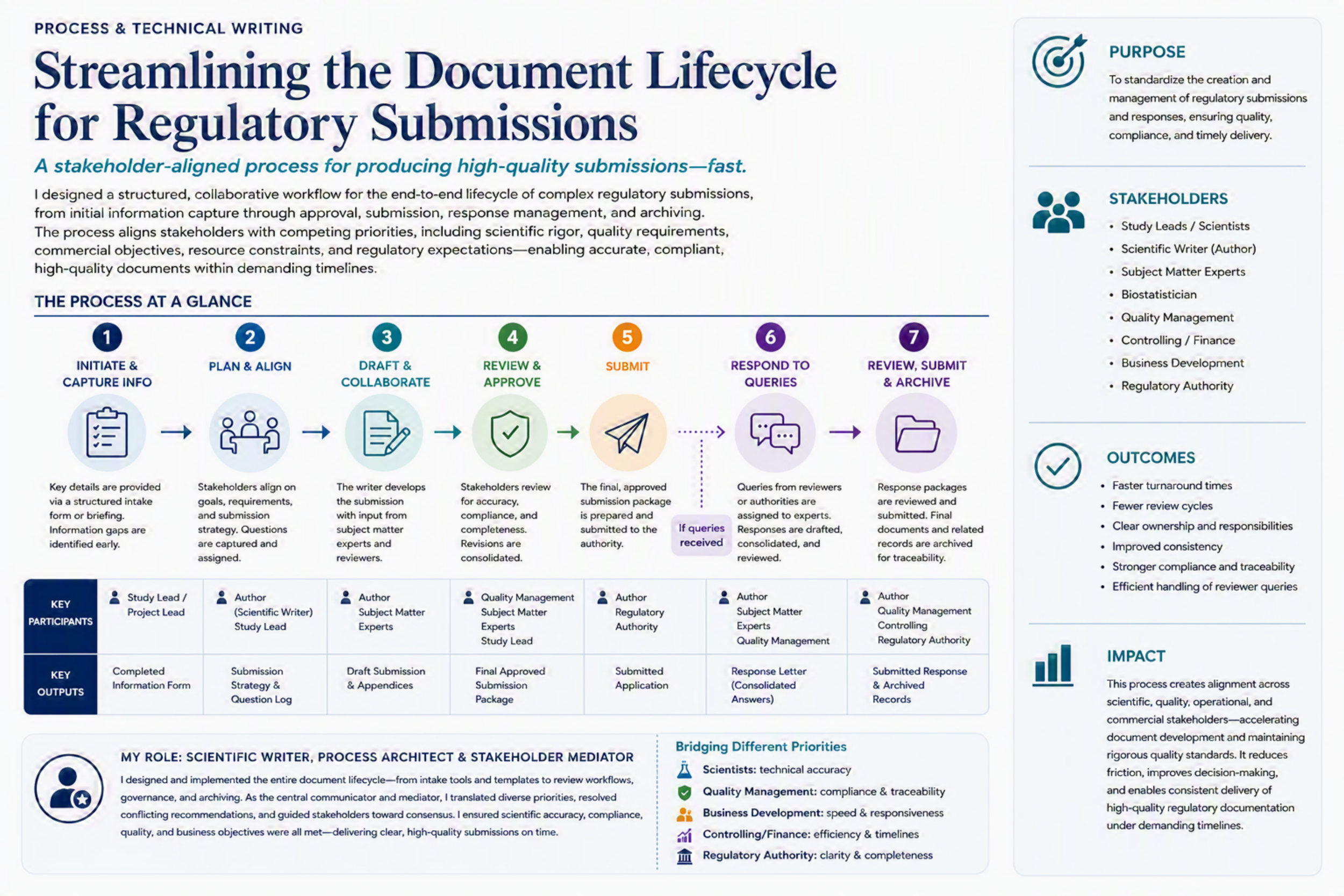
How a stakeholder-aligned writing framework reduced turnaround times while maintaining quality and compliance
In research-driven organizations, producing high-quality regulatory and governance documents often requires input from multiple stakeholders with competing priorities. Scientific teams focus on technical accuracy, oversight functions focus on compliance and ethical standards, while business stakeholders prioritize speed and operational efficiency.
One of the most common challenges in these environments is not the writing itself, but the coordination of expertise, reviews, approvals, and regulatory feedback within tight timelines.
As a Scientific Writer, I developed a structured document lifecycle process that transformed a fragmented, stakeholder-heavy workflow into a streamlined and scalable system. The framework established clear responsibilities, standardised communication, and accelerated document development without compromising quality.
The Challenge
The organisation needed a way to:
Coordinate contributors from different disciplines and departments
Create complex submission documents in a consistent format
Maintain compliance and quality standards
Reduce delays caused by unclear ownership and review cycles
Efficiently respond to authority or reviewer questions
Create traceable documentation and archiving practices
The primary obstacle was stakeholder alignment. Experts were highly knowledgeable in their respective fields, but each group approached projects with different objectives, terminology, and timelines.
My Approach
Rather than focusing solely on document creation, I designed an end-to-end process covering the entire document lifecycle:
Information collection and project initiation
Strategic planning and stakeholder alignment
Draft development and collaborative review
Approval and submission readiness
Response management for external inquiries
Final approval, submission, and archiving
To support the process, I established:
Standardised intake forms
Structured question catalogs
Writing templates
Review workflows
Defined stakeholder responsibilities
Controlled version management and documentation practices
This transformed document creation from an ad hoc activity into a repeatable business process.
Process Overview
The workflow was designed to ensure that the right expertise was involved at the right time while preventing unnecessary review loops.
Phase 1: Initiate & Capture Information
Project leads provide essential background information through a structured intake process. Information gaps are identified early to avoid delays later in document development.
Phase 2: Plan & Align
Key stakeholders review the project goals, compliance requirements, and submission strategy. Open questions are captured and assigned to subject matter experts.
Phase 3: Draft & Collaborate
The writer develops the submission package while coordinating input from technical experts, reviewers, and oversight functions.
Phase 4: Review & Approve
Stakeholders evaluate the draft for accuracy, compliance, and completeness. Revisions are consolidated and incorporated into a final version.
Phase 5: Respond to Queries
When questions arise from reviewers or external authorities, responses are distributed to the appropriate experts, consolidated into a single response package, and reviewed for consistency.
Phase 6: Final Submission & Archiving
Approved materials are submitted and archived according to established documentation practices, ensuring traceability and future accessibility.
Key Outcomes
The process delivered measurable operational benefits:
Faster document turnaround times
Better stakeholder alignment
Fewer review cycles
Clear ownership and responsibilities
Improved consistency across submissions
Stronger compliance and traceability
More efficient handling of reviewer questions
Most importantly, the framework enabled experts with very different priorities to work toward a common objective without sacrificing scientific rigor, quality standards, or project timelines.